KNOW WHAT APPLIES TO YOU
Roadmap
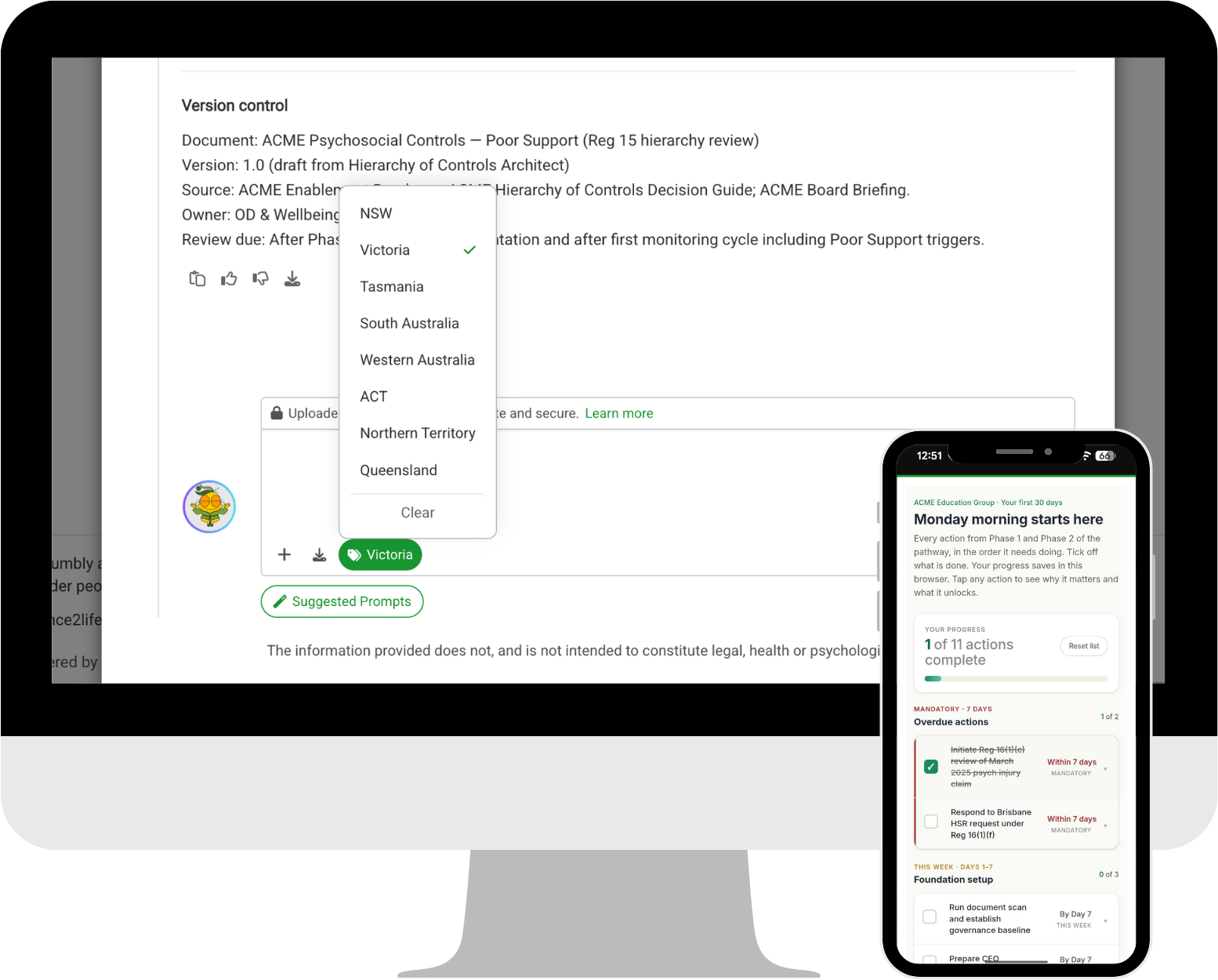
Your obligations by jurisdiction, your current governance baseline, and the order things need doing in. A starting point, not a strategy document.
Winner — Best WHS Training Program, 2026 Hunter Safety Awards
Meet Gentia.
Gentia continuously connects the signals already inside your organisation
into a live workforce fingerprint. Its AI reasons across that fingerprint
to show where people-related risk is building, what is driving it,
and the action most likely to change the outcome — so you can make better people decisions with precision.
signals → fingerprint → reasoning → decision → action
Psychosocial risks don't stay contained as safety issues. They drive turnover, disengagement, lost productivity and failed change. Gentia identifies where the risks are building and applies the controls that improve both workforce health and business performance.
THE SYSTEM
Identify the hazards. Consult your workers. Train the people who need it. Build the controls. Evidence all of it, for a regulator who may ask. Most organisations run that across a survey tool, an LMS, a consultant, a risk register and a SharePoint folder, and none of them talk to each other. Gentia is one system, and everything it produces feeds the next thing it does.
WHAT IT RUNS ON
14+ years of practice and 10,000+ expert-labelled risk attributes, mapped to Australian WHS law and ISO 45003.
The structure, roles, workforce data, incidents, exits and change activity you already hold, connected into one picture the AI can reason across.
WHAT RUNS ON IT
KNOW WHAT APPLIES TO YOU
Your obligations by jurisdiction, your current governance baseline, and the order things need doing in. A starting point, not a strategy document.
CONSULT YOUR WORKERS
Consultation is a duty, not a survey. AI-led interviews that adapt to what each person actually says, with what they told you captured as evidence.
MAKE SURE PEOPLE UNDERSTAND
Specialist psychosocial modules built from your fingerprint, with an AI agent alongside each one so people can ask questions and learn in the way that suits them. What they learned comes back into the system.
CONTROL THE BIGGEST VARIABLE
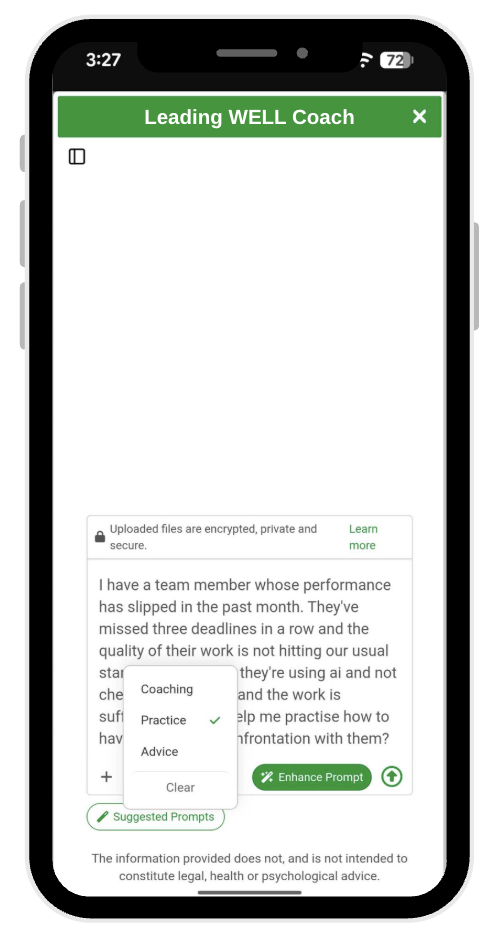
Manager behaviour is a control. Coaching aimed at the hazards your own data shows, measured by 360 assessment against the risk matrix.
GET AHEAD OF NEW RISK
Test whether an AI rollout will add demand, rework and role confusion before you run it, and capture what your workforce is genuinely ready for.
EVIDENCE ALL OF IT
Risk registers, control records, board papers and regulator responses, written to your jurisdiction with the clause cited and the source attached.
The assessment, the training completion, the manager's 360, the control you applied and the board paper all sit in the same system. Each one makes the next answer more accurate, and every finding traces back to where it came from.
A general model can tell you what good looks like. It cannot hold your evidence.
How Gentia knows
Most AI is model-first: a general model, guessing at your context.
A general-purpose model tells you what is generally true about psychosocial safety. Gentia tells you what is actually happening in your organisation, what you did about it, and whether it worked — with the evidence attached.
Reasoning
Answer
Both divisions are showing rising work demands, but not in the usual survey data. Experienced practitioners have been replaced by less experienced hires, leaving managers to absorb more complex work and supervision.
Smaller divisions with similar roles haven't seen the same shift — or the same turnover.
The immediate risk is concentrated in three operationally critical teams. Reducing manager load and restoring experienced capability there is the highest-value control.
Every statement links back to the evidence it came from.
Gentia takes fragmented workforce and operational signals, connects them into an organisation-specific workforce fingerprint, reasons across it with AI, and turns the insight into practical action.
Signals
Gentia reads the workforce and operational information your organisation already produces — from structure, roles and workforce data to surveys, incidents, exits and change activity.
Fingerprint
Each signal becomes part of a connected, organisation-specific picture. On their own, the signals say little. Together, they reveal patterns AI can reason over.
Insight
Gentia shows where people-related risk is building, what is driving it, how significant it is, and the evidence behind the finding.
Action
The insight becomes a practical next step — from a control or intervention to targeted coaching for the manager or leader best placed to act.
What Gentia reads
From scattered information to a specific action, with the reasoning attached.
Worked example
Each step adds one piece of information and one inference. The stack resolves into a specific risk and a specific control. Here's an AI rollout, as an example.
A new AI tool is scheduled to go live for a 200-person team in three months. Gentia logs it as a change event. On its own, that's just a project.
Training is scheduled and funded. So this isn't simply a skills gap — and Gentia stops treating it as one.
AI readiness data shows people are already using AI, but checking is inconsistent and rework is common. Adoption is happening faster than good judgment is developing.
Role clarity is already low, and team leaders have the widest spans of control in the business. It is unclear who owns the quality of AI-assisted work when it moves between people.
Workloads are already high and no time has been created for experimentation or verification. People are being asked to learn, use and check AI while maintaining the same output expectations.
AI increases activity, but also rework, checking burden and decision load — compounding high job demands and low role clarity in a team with little capacity to absorb mistakes. Rated: High.
Not more training. Clarify accountability for AI-assisted work, reduce output expectations during the transition, and create protected time for testing and verification. Re-rate at four weeks.
Where we're inferring, we say so — and we tell you exactly what would confirm it.
A leadership coach, meeting a manager with coaching support targeted to reducing psychosocial risks.
Coaching in the flow of work
When Gentia sees a risk building, it doesn't file a report. A coaching agent reaches the manager who owns the fix, with coaching already prepared: what's happening, why it matters, and the next action.
No new dashboard. No new login. The nudge arrives in the flow of the day, sized to fit it, with follow-up tracked so nothing slips.
Where is risk building?
What is driving it?
What does this manager need to do next?
Who it's for
One finding, three different needs. Same evidence.
Gentia insight
Turnover risk is rising in two divisions. Managers are carrying larger teams and more complex work after experienced roles were replaced with less experienced hires.
See where workforce risk is concentrated, what it is costing the organisation, and whether current controls are reducing it.
See which teams are exposed, the conditions driving that exposure, the controls most likely to reduce it, and the evidence behind each finding.
Get the specific action, context and coaching needed to address the risk — in the flow of work, not in another dashboard.
These are the questions organisations actually ask when they come to us. Gentia answers them from the information you already hold.
Usually because the same teams are absorbing change after change with no adjustment to workload, role clarity or expectations. Gentia shows which teams are carrying that load, what it's doing to them, and what to change before the next project starts.
Start with a RoadmapGentia identifies where manager capability and manager load are creating risk in a team, names the specific behaviours involved, and puts targeted coaching in front of the people who need it.
See Leading WELLAdoption metrics tell you who logged in. Gentia shows you where AI is creating genuine value, where it's creating rework and checking burden, and what needs to change around the work for a rollout to land.
See the AI Readiness ExperimentGentia finds where people are most likely to leave and why, traces it to the working conditions behind it, and puts a specific control in front of the manager who can change them.
Start with a Discovery BriefGentia is built on 14+ years of specialist psychosocial safety practice, encoded into the system the AI reasons on. We only claim what the evidence carries — and where we're inferring, we say so.
Winner
Awarded for Leading WELL, Gentia's leadership program. Judged on evidence, measurable outcomes and the ability to scale.
managers completed the program in one deployment
team members reached through them
psychosocial hazards moved down the risk matrix, independently evaluated
expert-labelled risk attributes behind every answer
Start with a Discovery Brief. A short conversation, plus whatever you already have, and you'll get back a brief on what matters in your organisation, the reasoning behind it, and what it could be costing.
Opens your email app, addressed to hello@gentia.ai. Nothing to prepare. No survey to run. No integrations, and no IT procurement.
FAQ
Gentia is an end-to-end system for managing psychosocial safety. Australian WHS law requires organisations to identify psychosocial hazards, consult their workers, apply controls and evidence all of it, and most manage that across a survey tool, a learning system, a consultant and a folder of documents that do not talk to each other. Gentia brings it into one system: assessment, consultation, training, leadership development, controls and regulator-ready reporting, all built on the organisation's own workforce data. It runs on AI trained on 14+ years of specialist psychosocial safety practice, so it knows the legislation, knows the organisation, and shows the reasoning and source behind every finding.
Psychosocial risk is the risk to people that comes from how work is designed, organised and led — things like workload, role clarity, support, change and recognition. Under Australian WHS law, organisations must identify and control these risks the same way they control physical ones. Left uncontrolled, they show up commercially as turnover, absence, stalled change and lost productivity.
A general-purpose model tells you what is generally true about psychosocial safety. Gentia tells you what is actually happening in your organisation, what you did about it, and whether it worked — with the evidence attached. General models are trained on the public internet and have no access to your structures, your roles, your controls or your history. Gentia reasons over two things a general model doesn't have: an expert dataset built by psychosocial safety specialists and mapped to Australian WHS law, and a model of your own organisation built from information you already hold. Every answer traces back to the evidence it came from, and specialists validate material findings before they're relied on.
Gentia is built for organisations that carry a real psychosocial safety obligation and no practical system for meeting it. That includes mid-market and enterprise employers with distributed teams, high-pressure work or layered reporting lines, where risk is hard to see and harder to evidence. Inside those organisations it is used at three levels: executives who need to know where the business is exposed and what it is costing, people and safety teams who identify the risk and decide what to do about it, and the managers who apply the control and change how the work runs.
No. Gentia is the specialist system for psychosocial safety, and it sits alongside what you already run. Your HR system, engagement tools, general learning platform, incident reporting and risk register all stay where they are. Gentia reads what they hold, runs the psychosocial work on top of it, and keeps the assessment, the training, the controls and the evidence together in one place, so your psychosocial record is not spread across five systems that were never built for it.
No. Gentia starts with information your organisation already holds. Consultation — conversational interviews, check-ins and assessments — is part of what Gentia does and often follows, but it isn't required to begin.
Days rather than months. A Discovery Brief needs a short conversation and whatever you already have. The Roadmap, where most organisations start, takes three to four weeks and around two to three hours of your time. No integrations and no IT procurement are required to begin.
No. Gentia reasons over aggregate patterns at role, team and unit level. Personal details are removed before any AI processing. It's designed to surface risks in how work is designed and led — not to monitor, score or profile individual people.
All data is stored and processed in accredited Microsoft Azure data centres located in Australia. Your data is not transferred offshore.
No. Your information is never used to train public or third-party models. Learning improves your own organisation's knowledge layers only.
Yes. Every material finding carries citations to its source and a visible reasoning path back to the evidence it was built from. Specialists validate material findings before they're relied on. There are no black-box outputs.
Gentia is priced on the scope of the deployment. The Roadmap, Leading WELL and the AI Readiness Experiment can each be taken on their own, or as part of a full Gentia subscription. Start with a Discovery Brief and we'll scope from what it finds.