The AI Readiness Experiment
AI adoption shows efficiency.
AI readiness shows effectiveness.
Experiments reveal what needs fixing.
The AI Readiness Experiment combines real-world AI practice with structured reflection
to reveal capability, judgment and value — while the problems participants choose
surface patterns in workload, role clarity, change, support and work design that traditional surveys often struggle to see.
I ask questions, I don't hand out answers. Most problems get solved badly because they were understood loosely.
I'm your Diagnose Insight Navigator. I've read what you told us about your work, and for the next three days my job is to help you understand one problem properly before anything tries to solve it. Where would you like to start?
What this phase produces
One problem, precisely defined
Days 1 to 3Next: Design. Build the smallest version that could work.
The AI Readiness Experiment can be taken on its own, or as part of a full Gentia subscription.
The loop
Ten days, one real work problem, and a structured learning loop.
Participants begin by understanding how they currently work with AI, then choose a real problem from their own work. With AI acting as a coach, challenger and thinking partner, they diagnose the problem, design a small response, test it in practice and capture what happens.
- 1
Assess
Build a baseline of AI readiness — how you use AI, where you trust it, how you check it, and where it creates value or friction.
- 2
Diagnose
Choose a real work problem and use AI to unpack it with greater precision, surfacing patterns, assumptions and possible root causes.
- 3
Design
Turn that diagnosis into a small, practical response you can test in your real work.
- 4
Test
Put it into practice, gather feedback and use AI to challenge, analyse and refine what you are seeing.
- 5
Capture
Record what worked, what did not, where AI helped, where it added friction, and what the evidence actually shows.
- 6
Reflect
Distil what you learned about the problem, the solution and how you work with AI.
- 7
Reassess
Compare where you finish with where you started, and identify the next capability to build.
Participants finish with greater AI readiness, a deeper understanding of a real work problem, and either a useful solution or a valuable learning from what did not work. Both are meaningful outcomes.
Supported, not automated
What support do participants get?
Insight Navigators support participants at every stage of the loop, in five distinct roles: as a coach, as a challenger, as a synthesis partner, as a simulator, and as a thinking partner.
The challenger role matters most. When a participant's measure of success will not actually support the conclusion they want to draw, the Navigator says so, and shows its reasoning. That is the habit the program is building: not using AI faster, but knowing when its answer — or your own — does not yet hold up.
The human stays in the lead throughout. The Navigator does not do the work.
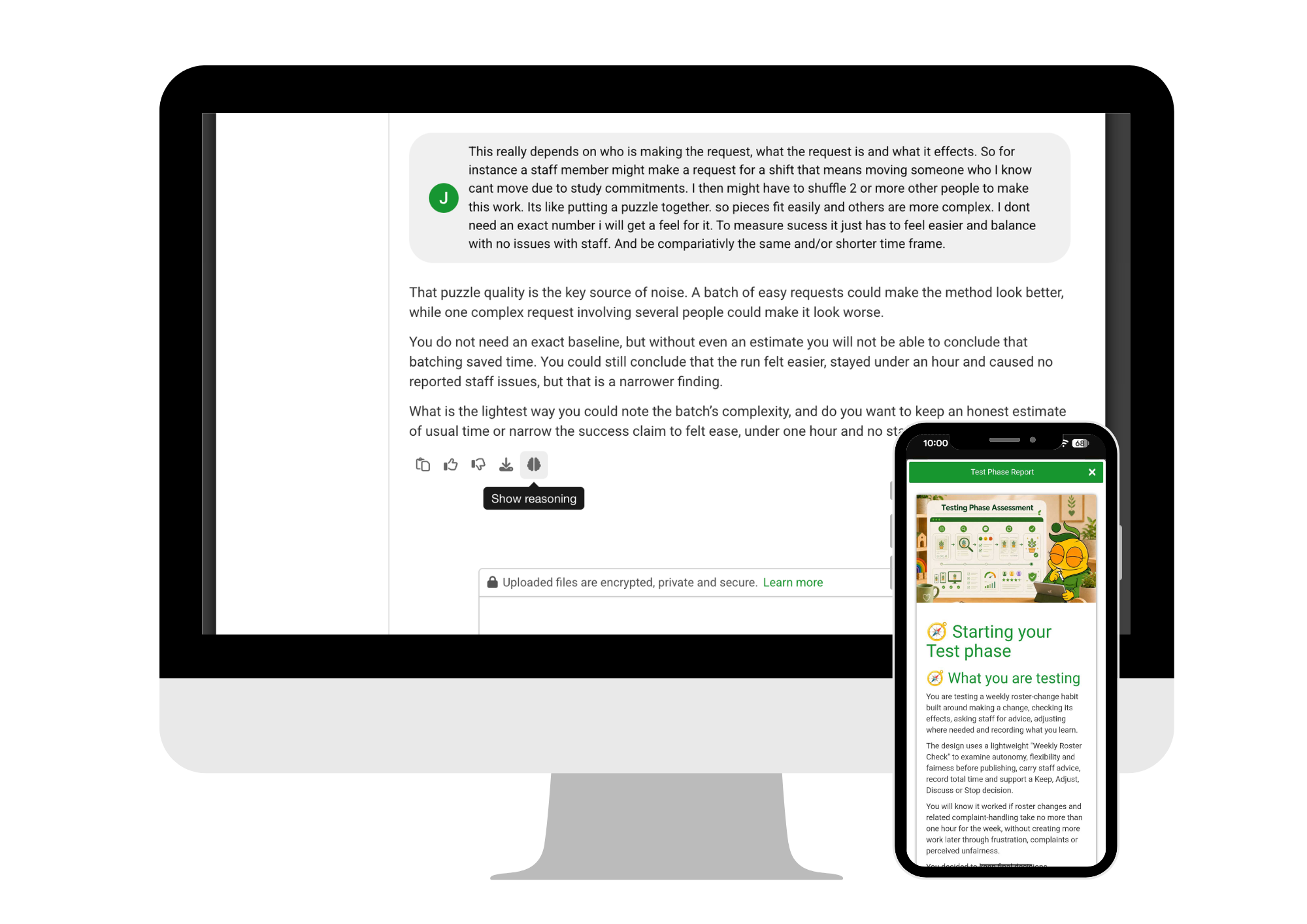
An Insight Navigator working through a real problem with a participant, with the reasoning shown.
For the individual
What do participants actually walk away with?
Judgment about when to use AI, and when not to
Practical confidence about which tasks AI genuinely improves and which it quietly makes worse.
The habit of challenging an output
How to interrogate an answer rather than accepting it, and how to tell a confident answer from a correct one.
Better context, better results
How to give AI the context it needs, which is the single biggest determinant of whether an output is useful.
Synthesis and testing
How to use AI to pull disparate information together, and how to test an idea before committing to it.
Independent judgment, retained
How to stay the decision-maker rather than drifting into ratifying whatever the model produced.
A real problem, better understood
A clearer understanding of a genuine problem in their own work — and either a solution or a useful finding about why it did not work.
For the organisation
What does the organisation learn?
Far more than an adoption dashboard can tell you — and it arrives in two layers.
Layer one — how people actually work with AI
Watching real people take a real problem through a real test surfaces what surveys ask about but rarely capture: where AI is creating genuine value, where it is creating rework or cognitive load, where people struggle to verify outputs, and where human judgment is quietly overriding AI. It also shows where environmental factors — unclear roles, high work demands, lack of time, poor support, change fatigue — are affecting whether adoption sticks.
Layer two — the problems people choose
The problems participants pick are themselves the data. Aggregated across a cohort, they reveal recurring patterns in workload, role clarity, workflow, support, change management and decision-making. Nobody is asked to rate their role clarity on a five-point scale. They simply choose what to work on, and the pattern emerges from the choices.
This is why the program produces evidence a survey cannot. It measures what people did, not what they said they would do.
Where it goes
How does this connect to the rest of Gentia?
Everything the Experiment produces feeds your organisation's workforce fingerprint — the live model of your organisation that Gentia reasons across.
Most organisations rely on surveys to understand things like verification behaviour, decision load and where judgment is being applied. Those are hard to measure and easy to answer inaccurately. The Experiment captures them from real work instead, which makes the fingerprint more precise in exactly the areas where it is usually weakest.
Real problems, real tests
People work on genuine problems using AI, and what happens is recorded.
Patterns emerge across the cohort
Recurring themes in workload, role clarity, support and decision-making become visible.
Your fingerprint gets sharper
The picture of where risk is building, and why, improves in the areas surveys measure least well.
Is this AI training, or is it analytics?
Neither, on its own. It is both, and that is the point.
Not simply AI training.
Training transfers knowledge. This builds judgment through real practice, on a real problem, with real consequences.
Not simply analytics.
Analytics observes from a distance. This generates its evidence from what people actually did.
A system, not a course.
People build better judgment through practice, while the organisation develops an evidence-based understanding of where AI is helping, where it is not, and what needs to change around the work itself.
“This has been a valuable experience for me to discover how to apply use of AI to improve my leadership skills and self-awareness. I wouldn't have otherwise considered use of AI in that context.”
FAQ
AI Readiness questions, answered.
The AI Readiness Experiment is a practical 10-day learning experience from Gentia where people build AI literacy, judgment and readiness by using AI on a real work problem of their own choosing. Participants assess how they currently use AI, diagnose a genuine work problem, design a small response, test it in real work, capture what happened, reflect, and reassess. The organisation gets a detailed picture of AI readiness as a result.
Ten days.
Not in the usual sense. Conventional AI training teaches the tool as a separate technical skill. The Experiment builds judgment through practice on a real work problem — when to use AI, when not to, how to challenge it, how to give it better context, and how to retain independent judgment.
A genuine problem from their own work, chosen by them. Not a case study and not a hypothetical. That is what makes the practice real and what makes the resulting data meaningful.
Two things. First, evidence of how people actually work with AI: where it creates value, where it creates rework or cognitive load, where people struggle to verify outputs, where human judgment is overriding AI, and where factors like unclear roles, high work demands, lack of time, poor support or change fatigue are affecting adoption. Second, the problems participants choose are themselves data — aggregated, they reveal recurring patterns in workload, role clarity, workflow, support, change management and decision-making.
A survey asks people what they think and how they behave. The Experiment observes what they actually did with a real problem under real constraints. It captures things surveys measure poorly — verification behaviour, decision load, and where judgment is genuinely being applied.
Insight Navigators are AI guides that support participants at each stage of the loop, working as coaches, challengers, synthesis partners, simulators and thinking partners. They question the participant's reasoning and show their own, but the human stays in the lead and does the work.
Gentia's position is that AI rollouts carry psychosocial risk, though the AI itself is not the hazard. Where AI increases activity without changing what is expected of people, it can compound recognised hazards — high job demands, low role clarity and increased decision load — particularly in teams with little capacity to absorb mistakes. That is why the Experiment measures the conditions around the work, not just the tool.
No. The Experiment works before a rollout, during one, or after a rollout that has not landed the way you expected. Running it before you commit is often the most useful, because it tells you what needs to change around the work first.
Any team or cohort where AI is being introduced, or where it is already in use and the organisation wants to know whether it is genuinely working. It requires no technical background.
Reporting to the organisation is aggregated — patterns, themes and conditions across the cohort. The Experiment is a development and diagnostic program, not a performance management or surveillance tool.
Everything the Experiment produces feeds your organisation's workforce fingerprint, the live model of your organisation that Gentia reasons across. It makes that fingerprint more precise in exactly the areas that are hardest to measure through surveys.
Yes. The AI Readiness Experiment can be taken as a standalone program or as part of a full Gentia subscription.
Start with a Discovery Brief.
A short conversation, plus whatever you already have. You get back a brief on what matters in your organisation, the reasoning behind it, and what it could be costing — including whether your teams are actually ready for the AI you have funded.
Nothing to prepare. No survey to run.