See where risk is building across every centre.
Act before it becomes turnover or a compliance breach.
Gentia is workforce risk intelligence for early education and OSHC, built by the team that ran Australia's largest corporate childcare group. It connects the signals already sitting across your centres, shows what's driving risk, and surfaces the control measures that reduce it.
Built from our proprietary childcare industry context engine.
Nothing for you to prepare.
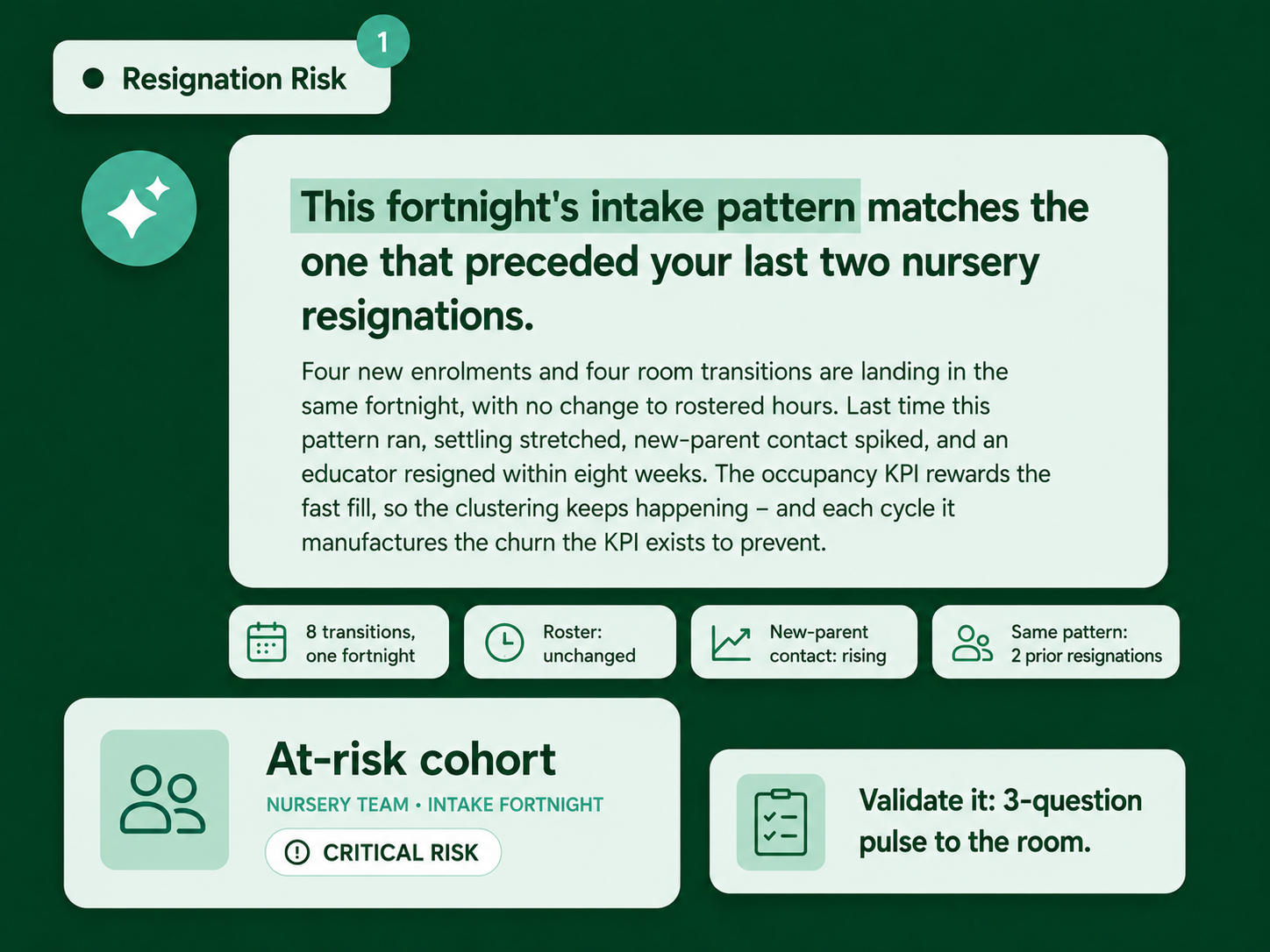
A resignation risk surfaced weeks early, with the reasoning behind it.
The people best placed to keep your team have the least time to see it coming.
Risk rarely arrives without warning. By the time someone resigns or a lapse is written up, the signs have often been building for weeks: disengagement, overdue documentation, thin cover, and families starting to lose confidence.
Centre and operations managers are best placed to control it, but they're stretched across ratios, rosters, families and compliance. The signals are there, scattered across surveys, rosters, incident logs and conversations, with no time to connect them.
Gentia connects the signals your managers don't have time to piece together, then coaches them to apply controls that effectively reduce the risk.
The missing link that brings three things together: lower turnover risk, stronger support for centre and operations managers, and better business performance.
Gentia runs a continuous risk assessment across your organisation. It surfaces the signals that point to workforce and compliance risk, rates how serious each one is, and recommends the control that reduces it, to the manager who owns the fix.
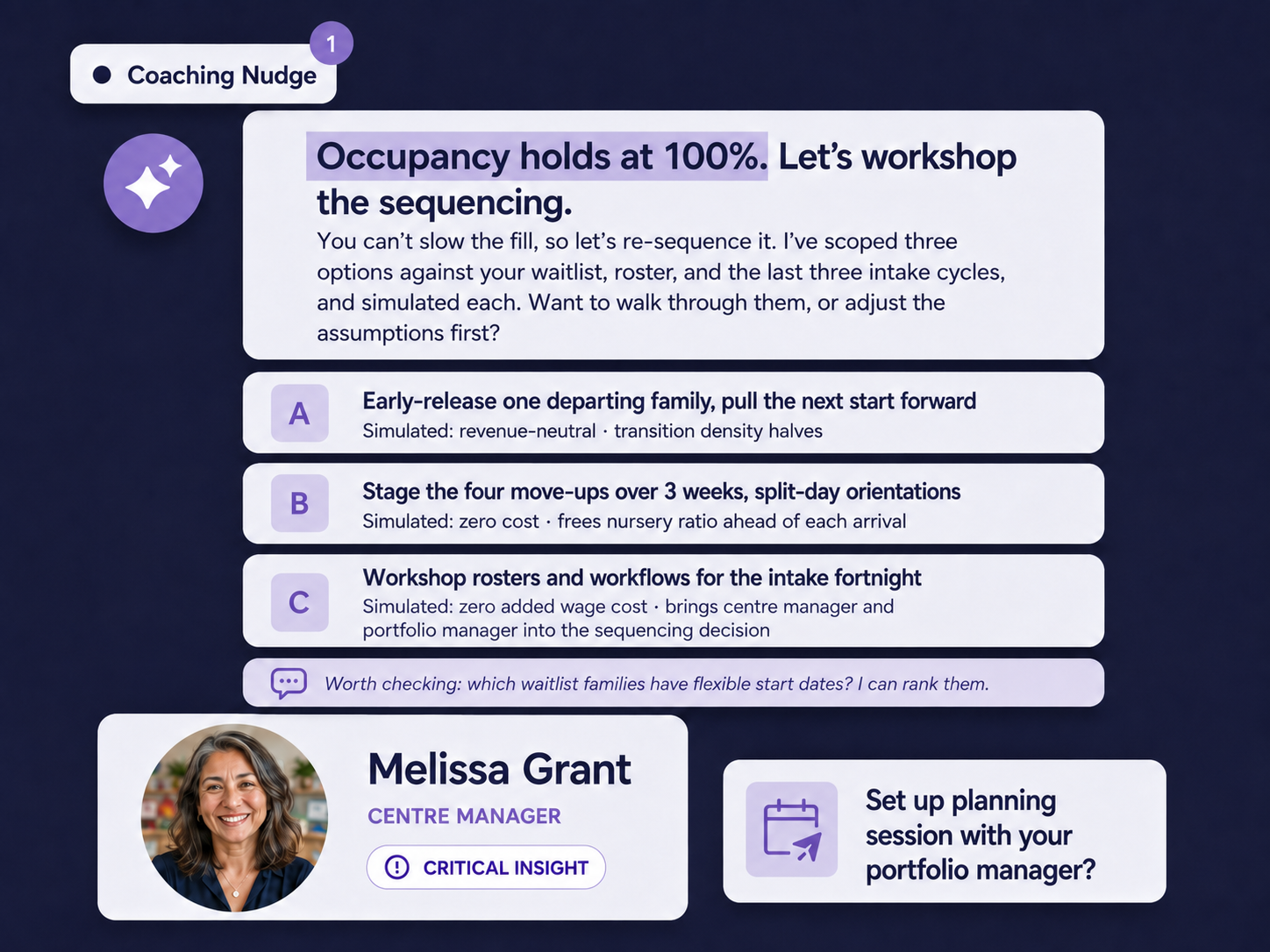
A coaching nudge delivered to a centre manager, with simulated options ready to workshop.
How Gentia works
Turning scattered workforce signals into clear, explainable actions for the manager who can do something about it.
Signals across your centres
Gentia draws on the workforce and operational signals already being created across your organisation.
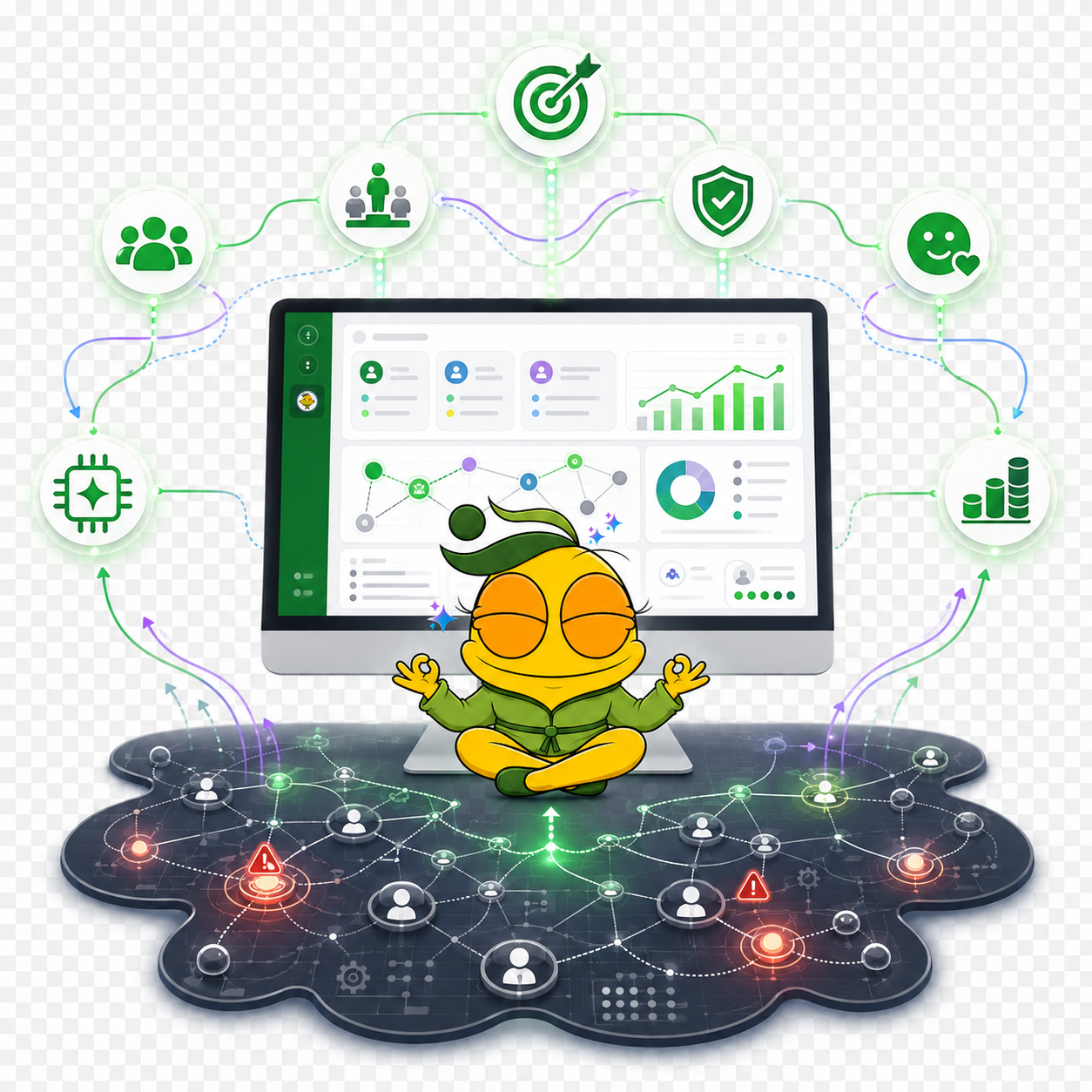
Gentia joins and interprets them
Gentia connects these scattered signals and reads them against an industry brain that already understands early education and OSHC: the work, the law, and what good practice looks like.
Turnover risk is rising at two centres, where thin staffing keeps pulling educators away from their own rooms and displacing the time they'd normally spend on programming.
- What is changing
- Why it matters
- Evidence traced to source
The risk and reasoning are surfaced
Gentia highlights where risk is building, what is driving it, and why it matters now. That includes drift from what the National Quality Framework expects, not just pressure on your people.
Recommended next step: protect programming time this week and check in with room leaders most affected by extra coverage.
The right manager receives the next action
The insight becomes practical coaching and a next step for the manager who owns the response.
Signals across your centres
Gentia draws on the workforce and operational signals already being created across your organisation.
Gentia joins and interprets them
Gentia connects these scattered signals and reads them against an industry brain that already understands early education and OSHC: the work, the law, and what good practice looks like.
Turnover risk is rising at two centres, where thin staffing keeps pulling educators away from their own rooms and displacing the time they'd normally spend on programming.
- What is changing
- Why it matters
- Evidence traced to source
The risk and reasoning are surfaced
Gentia highlights where risk is building, what is driving it, and why it matters now. That includes drift from what the National Quality Framework expects, not just pressure on your people.
Recommended next step: protect programming time this week and check in with room leaders most affected by extra coverage.
The right manager receives the next action
The insight becomes practical coaching and a next step for the manager who owns the response.
Signals across your centres
Gentia draws on the workforce and operational signals already being created across your organisation.
Gentia joins and interprets them
Gentia connects these scattered signals and reads them against an industry brain that already understands early education and OSHC: the work, the law, and what good practice looks like.
Turnover risk is rising at two centres, where thin staffing keeps pulling educators away from their own rooms and displacing the time they'd normally spend on programming.
- What is changing
- Why it matters
- Evidence traced to source
The risk and reasoning are surfaced
Gentia highlights where risk is building, what is driving it, and why it matters now. That includes drift from what the National Quality Framework expects, not just pressure on your people.
Recommended next step: protect programming time this week and check in with room leaders most affected by extra coverage.
The right manager receives the next action
The insight becomes practical coaching and a next step for the manager who owns the response.
Signals are connected, interpreted through early education context, explained clearly and turned into action.
Insight with precision, from day one.
Gentia isolates the working conditions you can actually control, tracing every risk directly to its source. It runs on four layers: our proprietary early education dataset, your organisation's own context, the AI models that reason across both, and the applications and agents that put the answer in a manager's hands. It maps time as well as risk, naming the pressure windows ahead before they converge.
Insights first, not model first. The AI sits on expert-built knowledge of your organisation, your industry and the law. It is never guessing.
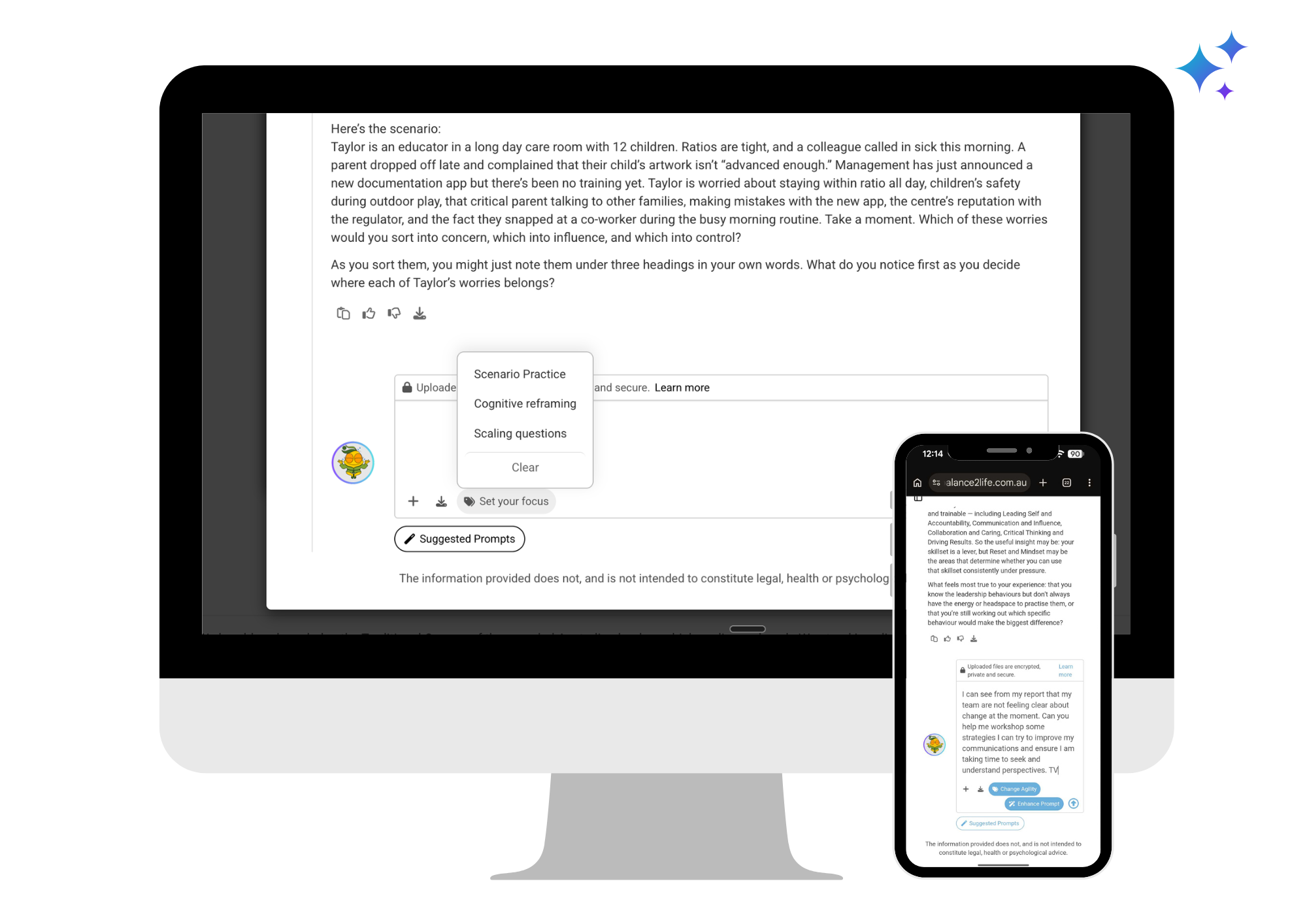
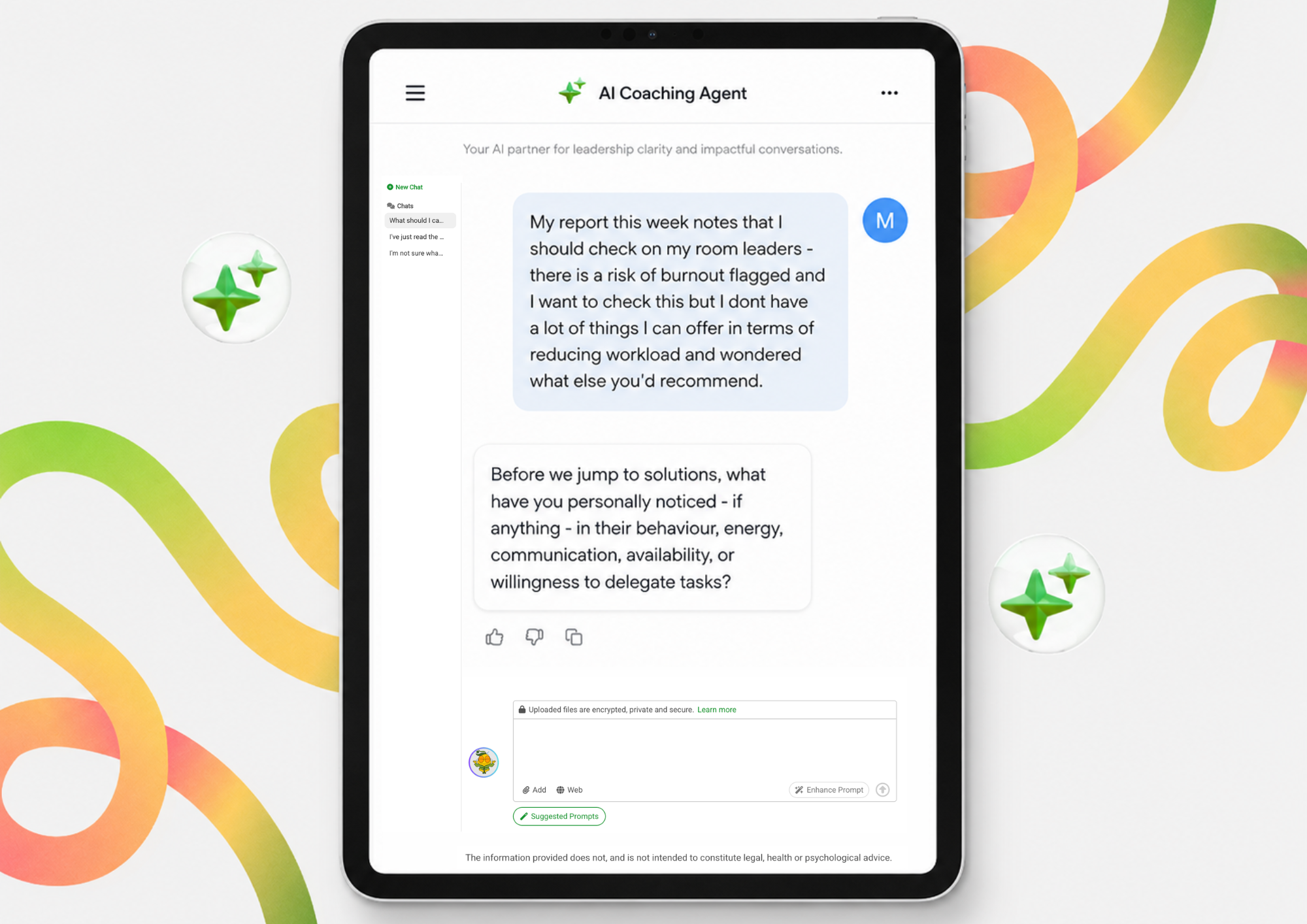
The AI coaching agent, meeting a manager where their questions actually arise.
The fix lands with the manager who owns it.
When Gentia sees a risk building, it doesn't file a report. It reaches the centre manager or operations manager who owns the fix, with the coaching already prepared: what's happening, why it matters, and the next action to take.
There's no new dashboard and no login to remember. The nudge arrives in the flow of their day, sized to fit it, and the follow-up is tracked so nothing slips.
Detect
Unifies your scattered people data and catches the early signals, then shows you exactly what's driving them.
Coach
Reaches the right manager at the right time, with the conversation prepared and mapped to who owns the control. Inside the tools your teams already use.
Predict
Model a restructure or change project before you run it and see where it creates new risk. Gentia's predictive models read your own history rather than static averages.
Who Gentia is for
The same workforce insight becomes useful in different ways depending on who needs to act.
Turnover risk is increasing in two centres due to repeated room coverage and reduced programming time, with documentation now overdue at both.
Their working conditions are understood
Their working conditions are understood. The signs affecting educators are connected so workload pressure, lost programming time and covering other rooms are visible before they become a resignation.
Sees where centres need support
Identifies which centres or OSHC services are under pressure, what local conditions are contributing, where compliance is drifting, and where manager support should be prioritised.
Receives practical coaching
Gets a clear next step and coaching guidance to support educators and reduce risk early.
Protect programming time this week and check in with the room leaders most affected by extra coverage.
Gentia is designed for multi-centre early education organisations that already hold useful workforce and operational information but struggle to turn it into timely action.
Built by people who've spent decades
inside early education and OSHC.
Years of early education, OSHC and childcare operations and business management expertise built into the platform.
Findings are explainable and traced to their source — no black-box scores, no anonymous alerts.
New employee surveys required to begin. Gentia works with the signals your organisation already generates.
"Gentia is the missing link between what our managers already sense and what they actually have time to act on."
— Approved provider
Start with one problem.
Keeping your best people.
Two to three hours of your time across three to four weeks. No technical integration to get started, and nothing needed from your centres until you choose to involve them.
Intake
Thirty minutes. You upload your core documents and complete a short intake on current priorities.
Consultation and audit
About ninety minutes. A facilitated session to sharpen the focus areas specific to your network, then a personalised audit completed through a secure link in your own time.
Your workforce fingerprint, delivered
Two to three weeks. Reports generate on submission. Your fingerprint becomes the roadmap the system reasons from, giving you bespoke reporting, continuous risk monitoring, and the applications and agents that control the risks it finds.
Start with a complimentary projection
See where risk may be building across your centres, what may be driving it, and what it could cost if nothing changes.
Complimentary projection
- ✓A centre-level view of likely workforce and compliance risk
- ✓The reasoning behind the findings
- ✓An example of the action Gentia would place with managers
- ✓A conversation with the Gentia team to examine the results
Nothing to prepare. No employee survey required.
See your complimentary projectionBuild your live Gentia system
Gentia connects more deeply with your organisational context and becomes an ongoing risk intelligence and coaching layer across your centres and services.
- ✓Run a continuous risk assessment across the network
- ✓Detect workforce and compliance risk earlier
- ✓Identify system-wide patterns
- ✓Support centre and operations managers
- ✓Track whether interventions are reducing risk
See where risk may already be building
Start with a complimentary Gentia projection and see what a continuous risk assessment could reveal across your centres.
Questions, answered.
No. Gentia works with aggregate workforce and operational signals at the team, room and centre level. It is designed to surface working-condition risks, not to monitor, score or profile individual employees.
Gentia draws on information your organisation already holds — rostering, surveys, reflections, HR and operational data — combined with its early education industry context engine. No new data collection is required to begin.
We build an initial centre-level turnover risk projection using our proprietary industry context engine and publicly available information about your organisation. You'll see where risk may be building, the reasoning behind it, and an example of the action Gentia would place with managers — then we walk through the results together.
No. Gentia is designed to work with the signals your organisation already generates. There is nothing for your teams to fill in and no survey fatigue to add.
Every finding is explainable and traced to its source. Gentia shows what is changing, why it matters and the evidence behind it, so managers can trust and act on the insight.
Insights and actions are role-based and delivered to the relevant people who own the controls. Centre owners and directors can access real-time reporting and Insight Navigators to query findings and refine solutions in natural language. Managers who own the controls — typically the centre manager or operations manager — can access practical coaching in the flow of their day, not as another dashboard to check.
The complimentary projection requires nothing from you to prepare. Building your live Gentia system starts with adding your organisational context and typically begins delivering insights within weeks, not months.
Your information is handled securely, used only to deliver Gentia's insights to your organisation, and never shared or used to train models for other customers. We're happy to walk through our data handling practices in detail.
Yes. Gentia is built for early education and Outside School Hours Care. The same risk model reads the signals your services produce, interpreted against the way OSHC actually operates: split shifts, casual pools, vacation care and coordinator continuity.
Yes. Gentia runs a continuous risk assessment across workforce and compliance risk together, because the same working conditions drive both. It surfaces drift from what the National Quality Framework expects, rates how serious each risk is, and recommends the control that reduces it.