Winner — Best WHS Training Program, 2026 Hunter Safety Awards

The Roadmap

Your workforce fingerprint
starts here.

Green fingerprint signal icon representing Gentia's workforce intelligence layer

A Psychosocial Risk Roadmap is a bespoke assessment of where psychosocial risk sits across your organisation, mapped against your obligations in every Australian jurisdiction you operate in, and delivered with a prioritised plan and the tools to act on it. It is where every Gentia engagement begins, and it is how your live workforce fingerprint is built.

Three to four weeks. Around two to three hours of your time. No integrations, no IT procurement, and no survey to run.

Why does every Gentia engagement start with a Roadmap?

Because you cannot manage psychosocial risk you have not identified — and most organisations have not formally identified theirs. The obligation to do so is in force in every Australian jurisdiction.

The Roadmap closes that gap. It establishes the organisational picture that everything else is built on, and it does so before you commit to a longer program of work. It is a practical management tool, not an exhaustive register of every issue that could be identified. It surfaces what matters most, in priority order, at a pace your organisation can absorb.

How it works

How does the Roadmap work?

The Roadmap runs in four stages. Each one adds to your workforce fingerprint.

1

Ingest and Map

We securely ingest the material you already have and build a context map unique to your organisation.

Policies, position descriptions, organisational structure, incident and claims data, workforce reporting, and any assessment work already completed. Personal information is redacted before any AI processing. That map then determines which questions are asked, of whom, and where the audit probes more deeply — which is why two organisations in the same industry receive materially different roadmaps.
2

Assess and Prioritise

We assess psychosocial risk across your workforce and prioritise what matters most.

Findings are structured across six domains: governance, policy, hazard identification, risk controls, monitoring, and role-specific risk. The assessment covers the hazard categories set out in the Safe Work Australia Model Code of Practice — including job demands, role clarity, support, change management, recognition and reward, and exposure to violent or traumatic events — calibrated to the work your people actually do.

3

Advise and Plan

We give you clear recommendations and a practical plan to reduce risk and strengthen performance.

Actions are prioritised across 30 days, 90 days, and 6 to 12 months. The plan sets out where you are now, where the highest-value actions sit, and how the effort already underway connects into a coherent system.

4

Act and Evolve

You implement with confidence. We track progress, and the fingerprint evolves.

As controls are implemented and information is added, the picture updates. Reporting is generated from your own data on demand rather than rebuilt by hand each time it is requested.

A continuous cycle of insight and improvement

Signals from across your organisationAI reasons across your dataRisk and its drivers are revealedActions are prioritised for impactOutcomes improve and the fingerprint evolvesback to the start

Delivered in the platform

Is the Roadmap a report, or a system?

It is a system. The Roadmap is delivered live inside the Gentia platform, not as a static document that is out of date the week after you receive it.

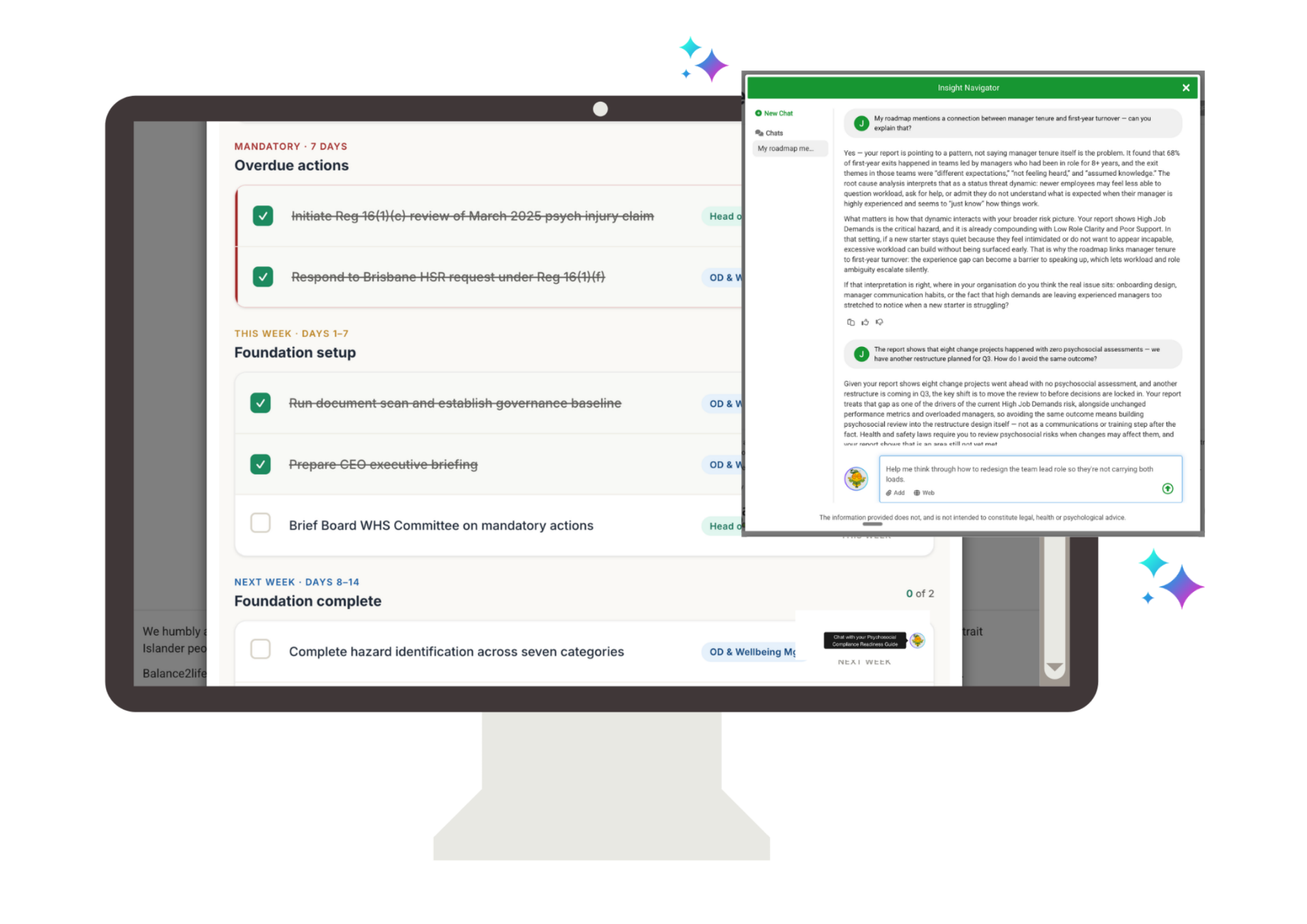
As controls are implemented and information is added, the picture updates. Alongside your results sit Insight Navigators — AI guides you can question in plain English about your own findings, with the reasoning shown and every answer traced back to the evidence it came from.

The Gentia platform showing a prioritised psychosocial risk action list with an Insight Navigator open alongside it.

Your roadmap, delivered live in the platform, with an Insight Navigator open alongside it.

What you get

What do you actually receive?

Documented hazard identification

Your psychosocial hazard identification, documented and structured across six domains and covering the hazard categories in the Safe Work Australia Model Code of Practice. This is the evidence base you can put in front of a board, a regulator or a partner.

An interactive roadmap

A prioritised action plan organised across 30 days, 90 days and 6 to 12 months, delivered by a Gentia consultant, and housed in the platform so it stays current.

The enablement view

The same findings presented against business outcomes — where psychosocial risk is likely to be affecting the measures you already report on, and what improvement looks like as controls go in.

Insight Navigators

AI guides loaded with your results. Explore findings, test scenarios and build implementation plans by asking questions in plain English, with the reasoning shown and citations to source.

Outputs on demand

Board reports, risk registers, gap analyses, heatmaps, employee communications, consultation design and evidence files — generated from your own data in minutes.

An executive business case

A one-page brief for your CEO and general managers: the current position, the obligations, the priority actions, and what the business gains from acting.

All report and roadmap data remains yours.

Your time

How much work is this for you?

Around two to three hours of your time, across three to four weeks.

1

Intake

You · 30 minutes

Upload your core documents and complete a short intake on your current priorities.

2

Context mapping

Gentia · runs in the background

We build your context map. It determines where the audit probes more deeply and shapes the questions, the reporting and the AI agents that follow.

3

Consultancy session

Joint · 60 minutes

A facilitated session to add qualitative context, test assumptions and sharpen the focus areas specific to your organisation.

4

Audit

You · 45 to 60 minutes

A personalised audit questionnaire completed through a secure link, in your own time. The questions reflect your context rather than a standard survey.

5

Roadmap delivery

Gentia · 2 to 3 weeks

Reports generate automatically on submission. Your interactive roadmap is then delivered by a Gentia consultant, together with the Insight Navigators and the implementation tools in the platform.

What do you need before you start?

Nothing you do not already have.

No integrations.

The Roadmap connects to none of your systems.

No IT procurement.

Nothing to buy, install or get approved.

No employee survey.

Worker consultation follows the Roadmap rather than preceding it.

No data preparation.

We work from the material your organisation already holds.

Not included in a Roadmap: physical safety review, training delivery, legal advice, and system integrations.

Where it leads

Where does the Roadmap take you?

Managing psychosocial safety well happens in four steps. Most organisations are at the first, and the Roadmap is how you get there.

1. See what's there

You have a documented picture of where psychosocial risk sits and how it maps to your obligations. The Roadmap gets you here.

2. Hear from your people

Worker consultation is added, so what people actually experience becomes part of the picture rather than something inferred from it.

3. Prove it's controlled

Controls are in place, evidenced and monitored. You can show not only what you found, but what you did about it and whether it worked.

4. Get ahead of it

You can describe a change before you make it — a restructure, a site change, a shift in how work is allocated — and see which teams would move into a higher exposure band under the same rules used to rate them today. It is a projection against a described future, re-rated as evidence arrives, not a prediction about any individual.

What happens after the Roadmap?

Whatever you choose. The Roadmap is built to work as a standalone engagement.

Proceed on your own

Implement the recommended controls using the roadmap and the tools in the platform. The engagement is complete and nothing further is owed.

Activate specific capabilities

Take up individual elements where the roadmap shows the highest value — leadership capability development, worker consultation, or ongoing monitoring and reporting.

Continue with Gentia

Move to an ongoing subscription. Everything added from that point continues to build your fingerprint rather than starting again, so the picture of where risk sits and how it connects to performance becomes more complete with each piece of work.

The Roadmap can be taken on its own, or as part of a full Gentia subscription.

Australian data centres

Your data is stored in accredited data centres in Australia.

Personal details redacted

Names, emails and phone numbers are removed before any AI processing.

No training on your data

Gentia does not train its models on client data.

Expert in the loop

Every material finding is reviewed by a Gentia specialist before delivery.

Built on 14+ years of specialist psychosocial safety practice, across all eight Australian jurisdictions, kept current with legislation and the Safe Work Australia Model Code of Practice.

FAQ

Roadmap questions, answered.

A Psychosocial Risk Roadmap is a bespoke assessment of where psychosocial risk sits across your organisation, mapped against your obligations in every Australian jurisdiction you operate in, and delivered with a prioritised action plan and the tools to carry it out. It is produced by Gentia, an Australian psychosocial safety platform, and it is delivered live inside the Gentia platform rather than as a static report.

Yes. The Roadmap produces documented psychosocial hazard identification covering the hazard categories set out in the Safe Work Australia Model Code of Practice, structured across six domains: governance, policy, hazard identification, risk controls, monitoring, and role-specific risk. The duty to identify hazards remains yours as the organisation — what the Roadmap gives you is the documented assessment and the evidence trail behind it.

Three to four weeks, from document upload to roadmap delivery.

Around two to three hours in total: 30 minutes of intake, a 60-minute consultancy session, and 45 to 60 minutes to complete a personalised audit.

No. The Roadmap works from information your organisation already holds. Worker consultation follows the Roadmap rather than preceding it, because the Roadmap is what tells you who to consult and what to ask them.

No. The Roadmap requires no integrations and no IT procurement. Nothing connects to your systems at this stage.

All eight. Each jurisdiction is treated separately, because the obligations differ, and the platform is kept current with legislation and the Safe Work Australia Model Code of Practice.

Documented hazard identification, an interactive prioritised roadmap across 30 days, 90 days and 6 to 12 months, an enablement view showing the same findings against business outcomes, Insight Navigators loaded with your results, outputs on demand including board reports and risk registers, and a one-page executive business case. All of it remains yours.

A Gentia consultant delivers your roadmap. Gentia combines psychosocial safety and organisational development specialists with AI, and every material finding is reviewed by a specialist before it reaches you. AI supports expert judgement rather than replacing it.

No. Every Roadmap is built from a context map unique to your organisation, drawn from your own material. That map determines which questions are asked, of whom, and where the audit probes more deeply. Two organisations in the same industry receive materially different roadmaps.

No. Gentia does not train its models on client data. Personal details are redacted before any AI processing, and your data is stored in accredited Australian data centres.

No. The Roadmap can be taken as a standalone engagement, or as part of a full Gentia subscription. If you proceed independently afterwards, nothing further is owed.

Three things are possible: implement the recommended controls yourself using the tools in the platform; activate specific capabilities where the roadmap shows the highest value; or move to an ongoing subscription, where everything added continues to build your workforce fingerprint rather than starting again.

Start with a Discovery Brief.

A short conversation, plus whatever you already have. You get back a brief on what matters in your organisation, the reasoning behind it, and what it could be costing — and a clear view of whether a Roadmap is the right next step.

Nothing to prepare. No survey to run.