Reset
From surviving to thriving
Energy management, stress recognition, boundary setting, recovery habits, and staying deliberate under pressure.
Winner — Best WHS Training Program, 2026 Hunter Safety Awards
Leading WELL
Leading WELL is a 30-day, cohort-based leadership program that treats manager behaviour as a genuine control against psychosocial risk, aligned to the Safe Work Australia Model Code of Practice and ISO 45003. Managers shape how people experience work more than almost anyone else. Leading WELL turns that influence into your strongest control against workplace stress — and measures whether the change holds.
LEADER BEHAVIOUR
Delegation breaks down under change
PSYCHOSOCIAL HAZARD
Lack of role clarity
RISK: HIGHBUSINESS OUTCOME
Turnover and disengagement
HIGH → LOW
Role clarity on the risk matrix
47%
more likely to hold the team accountable
80%
now seek others' perspectives
Leading WELL can be taken on its own, or as part of a full Gentia subscription.
What it is
Most leadership training tells managers what good looks like. Leading WELL changes what they do, then measures whether the change holds — and traces it back to the psychosocial hazards that drive workplace stress.
That is the difference between a course and a control. A course reports satisfaction. A control produces evidence that a hazard moved.
Reset
Energy management, stress recognition, boundary setting, recovery habits, and staying deliberate under pressure.
Mindset
Growth mindset, comfort with uncertainty, feedback seeking, progress over perfection, and change agility.
Skillset
Active listening, clarity and delegation, difficult conversations, accountability with psychological safety, and ethical decisions.
Success looks like RISE. Respectful leaders who act on Inclusion, build Supportive teams, and make Ethical behaviour the norm.
How it is built
Before the program runs, Gentia builds your organisation's workforce fingerprint from information you already hold — roles, structures, engagement data, and the patterns in how work actually happens. A specialist reads it with you. That shows where the real risk sits, and then the program is pointed straight at it.
Roles, structure, engagement and incident data.
A live map of where risk sits and what is driving it.
Development aimed at the specific risks in your organisation.
If unclear roles are driving stress, the program builds the exact leadership behaviours that create clarity. The risk becomes the development focus. That is why the outcomes trace back to the risk matrix instead of stopping at a satisfaction score.
Your fingerprint is also used to build a bespoke 360 assessment for each manager, so development starts from what that manager actually does rather than a generic competency list.
How it runs
Thirty days, in cohorts, built on a 10/20/70 model.
10% — Learn.
Short weekly modules with practical frameworks.
20% — Practise.
Micro-actions applied to real work situations.
70% — Connect.
Facilitated cohort coaching that builds shared language and accountability.
Agree the priorities, the language and the outcomes that matter most.
Set expectations and prepare leaders to get the most from the experience.
Weekly modules, live facilitated coaching sessions, and practical behaviour-change nudges applied to real work.
A bespoke 360, built from your workforce fingerprint, that builds self-awareness at the start and measures behaviour change at the end.
A hub, a community of practice and quarterly sessions keep the change alive long after day 30.
Coaching in the flow of work
Every participant has a Leading WELL coaching agent, trained on their organisation's own context. It is available between sessions for reflection, practice and problem solving — a coach in the flow of the day rather than another system to log into.
Participants can point it at a specific focus area — mindset, skillset, change agility, building habits, or psychosocial safety management — and work through a real situation they are facing right now, not a hypothetical case study.
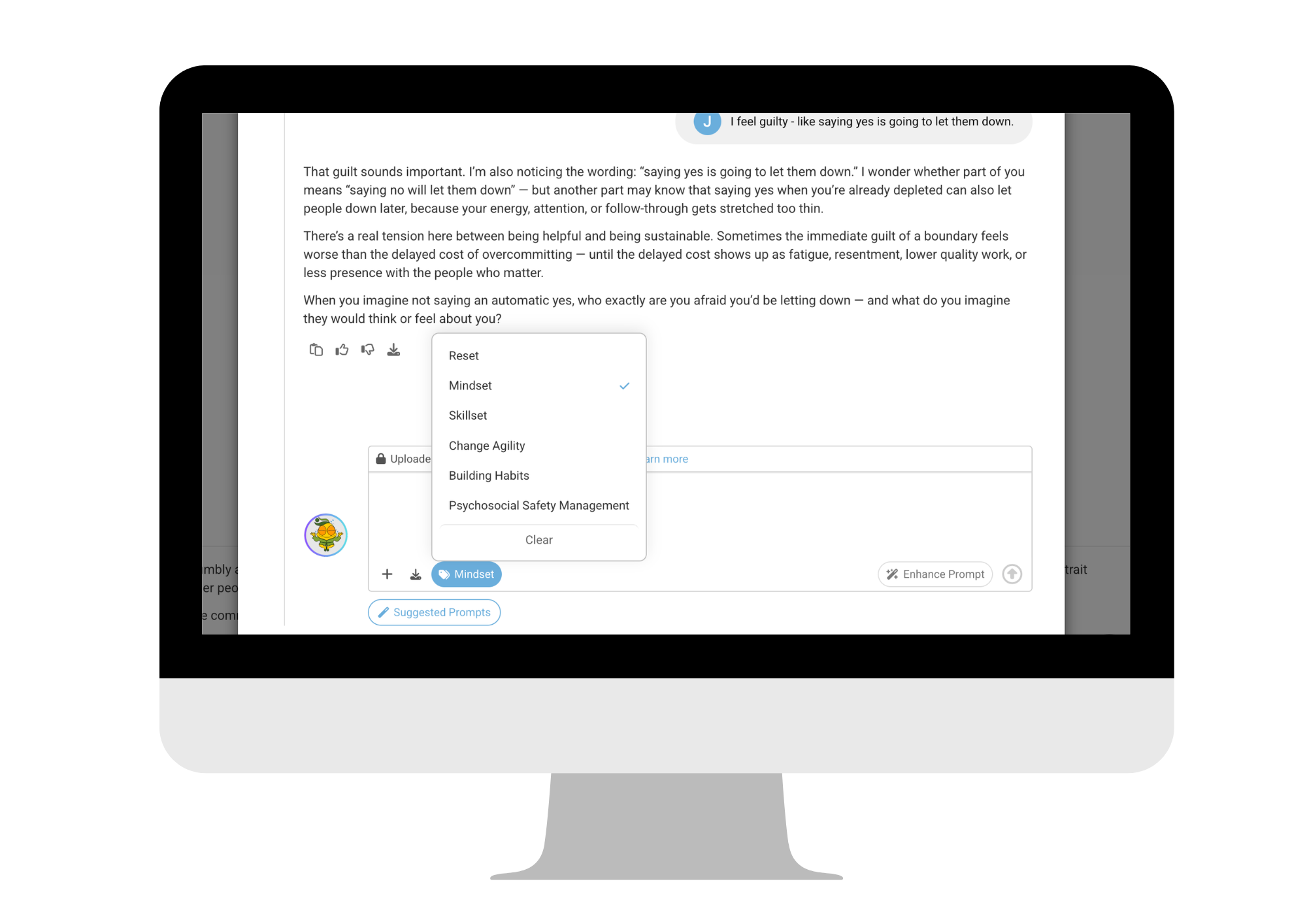
The Leading WELL coaching agent, available to every participant between sessions.
The proof
Leading WELL does not measure whether people enjoyed it. It measures what managers do differently, and traces that back to the hazards that drive workplace stress. Here is one chain, from a single deployment.
Lack of role clarity — a recognised driver of stress and burnout under the Safe Work Australia Model Code of Practice.
It traced to how leaders delegated under constant change. Unclear delegation produced unclear roles.
The program built each leader's awareness of when, with whom, and how their delegation was breaking down.
The pre and post 360 assessment showed managers holding their teams accountable more consistently, and actively seeking other perspectives before deciding.
Role clarity moved from High to Low on the risk matrix.
From one deployment, independently evaluated.
The shift shows up in ordinary moments rather than in a workshop. Managers speak up when something does not align with values. They handle conflict rather than avoiding it. They notice the conditions creating pressure on their team and adjust them. And they run regular wellbeing rituals instead of leaving it to an annual survey.
150
managers completed the program in one deployment
1,500
team members reached through them
90%
feel equipped to lead in ways that prevent workplace stress
3
psychosocial hazards moved down the risk matrix, independently evaluated
“This is by far the best and most practical leadership education I have ever received.”
At work, the manager is the relationship that shapes how people experience the job. Change the manager's behaviour and you change the conditions the team works under.
Wellbeing sits on a continuum, and every leader interaction either creates a sense of reward or a sense of threat. The program helps leaders own the shadow they cast and tilt their interactions toward reward.
Learning alongside peers encodes new behaviour more deeply and makes it far more likely to last than individual training does.
Reporting is aggregated. Leading WELL is a development program, not a performance management or surveillance tool.
Leading WELL was judged Best WHS Training Program at the 2026 Hunter Safety Awards, in a region built on mining, energy and heavy logistics. The criteria were evidence, measurable outcomes and the ability to scale — not how good the program felt, but whether it worked.
FAQ
Leading WELL is a 30-day, cohort-based leadership program from Gentia that treats manager behaviour as a genuine control against psychosocial risk. It is aligned to the Safe Work Australia Model Code of Practice and ISO 45003, targeted at the risks actually present in your organisation, and measured by behaviour change rather than satisfaction scores.
Ordinary leadership training tells managers what good looks like and measures whether they enjoyed it. Leading WELL identifies which psychosocial hazards are present in your organisation, builds the specific leadership behaviours that address those hazards, then measures the behaviour change by 360 assessment and traces it back to movement on the risk matrix.
The core program runs over 30 days in cohorts, with weekly modules, facilitated coaching sessions and practical actions applied to real work. Sustainment continues afterwards through a hub, a community of practice and quarterly sessions.
Australian work health and safety law requires organisations to control psychosocial hazards, including high job demands, low role clarity, poor support, poor change management and lack of recognition. Manager behaviour directly shapes several of these. Where unclear delegation is producing unclear roles, changing how managers delegate is a control on that hazard — and can be evidenced as one.
Before the program runs, Gentia builds your organisation's workforce fingerprint from information you already hold, and a specialist reads it with you. That shows where risk actually sits and what is driving it. The program is then pointed at those specific risks, and a bespoke 360 assessment is built for each manager from the same fingerprint.
Your workforce fingerprint is a live model of your organisation built from the information you already hold — structures, roles, work design, policies, controls and what people tell you, connected as one picture. It is what allows Gentia to show where risk is building and why, and it becomes more complete with every piece of work.
A multi-rater assessment built specifically for your organisation from your workforce fingerprint, rather than a standard competency questionnaire. It runs before and after the program, so it builds self-awareness at the start and measures what changed at the end.
No. Insight Navigators sit alongside reports and help you question your own findings. The Leading WELL coaching agent does work: it coaches participants through real situations between sessions, trained on their organisation's own context.
Reporting back to the organisation is aggregated — themes, shifts and where support is needed. Leading WELL is a development program. It is not a performance management, disciplinary or surveillance tool.
Not necessarily. Leading WELL can be taken as a standalone program. It works best where a workforce fingerprint already exists, because the program can then be pointed at known risks — which is what a Roadmap produces.
Yes. Leading WELL can be taken as a standalone program or as part of a full Gentia subscription.
Senior leaders, middle managers, supervisors and emerging leaders — the people whose day-to-day behaviour shapes how their teams experience work. It is designed for frontline and complex organisations.
In one deployment, 150 managers completed the program and 1,500 team members were reached through them. 90% reported feeling equipped to lead in ways that prevent workplace stress, and three psychosocial hazards moved down the risk matrix, with the results independently evaluated. Leading WELL was judged Best WHS Training Program at the 2026 Hunter Safety Awards.
A short conversation, plus whatever you already have. You get back a brief on what matters in your organisation, the reasoning behind it, and what it could be costing — including whether manager capability is where your highest-value action sits.
Nothing to prepare. No survey to run.