The Law Has Changed in Victoria. Can You Prove You're Compliant?
Victoria's Occupational Health and Safety (Psychological Health) Regulations 2025 commenced on 1 December 2025. The hard part isn't understanding the law. It's evidencing that you're meeting it.
Gentia · 9 December 2025
Victoria's Occupational Health and Safety (Psychological Health) Regulations 2025 commenced on 1 December 2025, with no transitional provisions. If you work in WHS or HR, you have probably read a dozen articles explaining what the regulations say.
This isn't one of those.
Because here's what most of that content misses: the hard part isn't understanding the law.
It's proving you're meeting it, when so much of psychosocial hazards live in everyday behaviour rather than documented procedure.
WorkSafe isn't going to ask whether you have a policy. It's going to ask what you did when workload became unsustainable. How you know your controls are working. What evidence you have that consultation actually happened.
That's a different challenge entirely, and it doesn't get easier with time. It gets harder, because the further you are from commencement, the longer the period a regulator can ask you to account for.
The real compliance gap
Most organisations aren't starting from zero. You have policies. You've done training. You care about your people.
But psychosocial hazards don't sit neatly in a register. They show up in:
- The manager who avoids difficult conversations until things escalate
- Workloads that quietly expanded during a restructure and never came back down
- Flexibility policies that exist on paper but feel career-limiting to use
- Feedback delivered under pressure that lands as humiliation rather than support
These are human moments. And they are now compliance moments.
The regulations require you to identify hazards, implement controls, consult workers, and review whether those controls are working. That's straightforward on paper. In practice, it means building a system that captures evidence of behaviour change, not just intent.
Three areas that matter most
If you're prioritising where to focus, these three carry the most risk and the clearest opportunity to demonstrate compliance.
1. Workload and role clarity
Chronic overload is one of the most common psychosocial hazards, and one of the hardest to control, because it creeps in gradually. Roles expand. Restructures drag on. High performers absorb more without complaining, until they can't.
Your evidence gap: can you show how workload is monitored? How concerns are escalated? What actually happens when someone raises it?
2. How difficult conversations are handled
Performance discussions, conflict, feedback under pressure — this is where psychosocial harm often starts. Not through malice, but through managers who haven't been equipped to have these conversations, or to regulate their own stress response while delivering a hard message.
Your evidence gap: can you demonstrate that leaders have been trained in how to hold these conversations, and not merely told that they should?
3. Consultation that's more than a tick-box
The regulations require genuine consultation with workers and health and safety representatives. That means input before decisions are made, not communication after the fact.
Your evidence gap: can you show that worker feedback shaped your controls, and that you followed up?
The pattern underneath all three
Look at those three evidence gaps together and the same shape appears in each.
In every case, the thing you need to prove isn't that something exists. It's that something happened, in sequence: you identified a condition, you did something specific about it, and you can show what changed as a result.
That is a much higher bar than a policy library, and it is not a bar you can clear retrospectively. You cannot reconstruct in March what you noticed in November. Either the trail was being built as you went, or it wasn't there to find.
An annual review produces a snapshot. The regulations ask for a record.
Where to start
If you can't currently answer the three questions above, the first task isn't writing another policy. It's establishing what your actual position is, in a form you could put in front of a regulator.
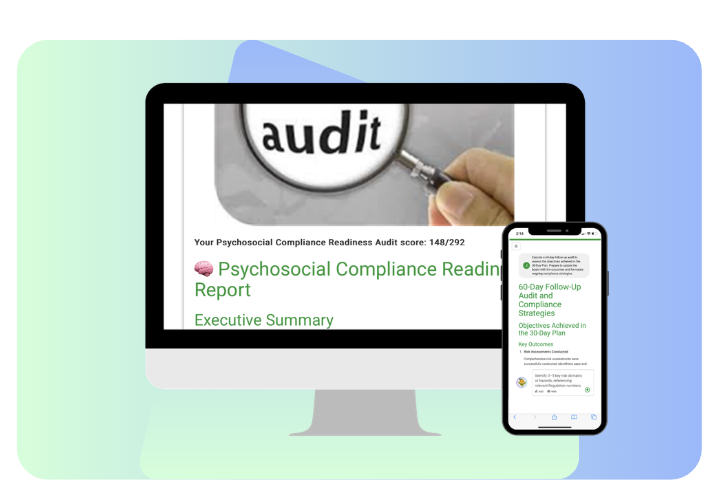
That's what a Gentia Roadmap produces. It works from the material your organisation already holds — policies, position descriptions, structure, incident and claims data, workforce reporting — and returns a documented assessment of where psychosocial risk sits, mapped against your obligations in Victoria and in every other jurisdiction you operate in, with a prioritised plan for closing the gaps.
Because it's delivered live in the platform rather than as a static report, the picture updates as controls go in, and the evidence pack builds as you go rather than being reconstructed before an audit.
Two things worth being straight about. Victoria's regulations sit separately from the Occupational Health and Safety Regulations 2017, and the obligations differ across jurisdictions — so if you operate in more than one state, each needs to be treated on its own terms. And the duty stays with you. A platform can help you identify hazards, design controls and evidence what you did. It cannot hold the duty on your behalf.
The regulations have been in force for a while now. The question a regulator will ask isn't whether you knew about them.
The organisations that will handle this well are the ones who can show their working.