The 1.6x Performance Gap: Why Your AI Strategy Needs a Human Layer
The real gap in AI performance isn't between companies with better tools and worse tools.
Gentia · 13 January 2026
For a while, a lot of the AI conversation sounded like a shopping exercise. Which tools are you using? Which platform did you choose? Which model is built into your stack? That is still how many leaders talk about AI maturity.
But the Deloitte data points somewhere much more useful.
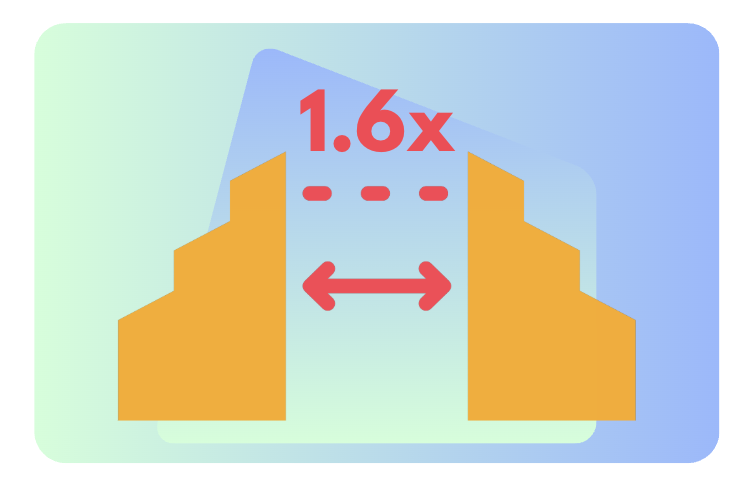
1.6x
how much more likely tech-focused organisations are to miss expected returns from AI, compared with those taking a human-centric approach
Source: Deloitte 2026 Global Human Capital Trends
The gap between organisations getting real value from AI and those falling short is not predominantly a tool gap. It's a design gap. Deloitte found that 59% of organisations are taking a tech-focused approach to AI, and those organisations are 1.6 times more likely to miss expected returns than those taking a human-centric approach.
In other words, the difference is not whether you bought AI. It is whether you designed how people and AI actually work together.
That lines up with what we have been seeing at Gentia for some time. The organisations that are getting traction from AI are not simply rolling out tools and hoping adoption sorts itself out. They're making deliberate choices about workflows, decision rights, trust thresholds, feedback loops, and manager support. They're treating the human system around AI as part of the strategy, not an afterthought.
The real differentiator is not the technology
This is the part we think a lot of leaders still underestimate.
Technology is increasingly available to everyone. Access is widening fast.
Features get copied.
Pricing shifts.
Vendors converge.
What does not get copied nearly as easily is the way an organisation chooses to redesign work around the technology.
Deloitte puts it plainly. As AI becomes part of everyday work, most organisations still are not intentionally designing how humans and machines interact, which limits returns and reinforces outdated processes. The same report says organisations that intentionally redesign roles, workflows, and decision-making for human and AI collaboration are more likely to exceed return expectations and deliver meaningful work.
That's a very different proposition from rolling out the tools and training people on them. It means leaders need to stop asking only whether their teams are using AI. They need to ask whether the operating model around that use makes sense.
Who owns the judgement?
When does AI advise, and when does it decide?
What gets escalated? What gets reviewed?
What work disappears, instead of simply speeding up?
Those are design questions.
And they're the ones that separate AI theatre from real value.
There is a 60-point gap between knowing and doing
One of the most useful numbers in the Deloitte report is not the 1.6x gap. It is the knowing-doing gap.
66%
of leaders say designing effective human and AI interaction is important to organisational success
6%
say they are making great progress on it
That is a 60-point gap between what leaders know matters and what they're actually building.
We believe that explains a lot of the frustration many organisations are feeling right now. They know AI changes more than output. They know it affects trust, judgment, accountability, and how teams coordinate. They know it changes the shape of managerial work. But many are still treating implementation as if it's mostly a training issue or a systems issue, which it is not.
You cannot prompt-engineer your way out of poor work design.
You cannot train your way out of unclear decision rights.
You cannot expect people to work well with AI if no one has designed the relationship between the human and the tool.
Intentional design is where the financial lift comes from
This is where the Deloitte data becomes hard to ignore. Organisations leading the way on intentional human and AI interaction design are nearly 2.5 times more likely to report better financial results, and twice as likely to say they provide meaningful work.
That should shift the whole conversation.
Because it means the human layer is not a nice extra once the real AI work is done. It's one of the main reasons AI pays off in the first place.
Deloitte also gives practical shape to what that design layer includes. Some of it is hardwiring: redesigned roles, accountability, decision rights, and escalation protocols. Some of it is softwiring: leadership behaviour, culture, trust, and the confidence people need to question, escalate, experiment, and learn with AI.
That distinction matters because a lot of AI rollouts are heavy on hard tech and very light on human design. They add a tool, maybe a policy, maybe a few guardrails, and then leave teams to work out the rest themselves.
That is usually where value starts leaking.
What a designed human layer actually looks like
One of the better examples in the Deloitte 2026 Global Human Capital Trends report is a large insurer that chose to use AI as a coach for its call centre workers rather than as a monitor of them.
It introduced AI-powered real-time coaching to help staff navigate emotionally charged calls with more empathy and effectiveness. The results were not abstract. Customer satisfaction went up 13%, call times fell, and associate stress dropped.
The company then extended the model so that AI monitors associate stress and prompts personalised recovery breaks after difficult calls.
That's a good example of what we mean by a human layer.
The organisation didn't just deploy AI into the workflow and call it innovation. It made a choice about the role AI would play.
It chose AI as a coach, not AI as a boss.
It designed the interaction around a human outcome as well as a business outcome.
And it kept evolving that interaction based on what workers actually needed.
That is the work most organisations skip.
And it is exactly why two companies can buy similar technology and get completely different outcomes from it.
AI is not the strategy. It serves the strategy
Josh Bersin has been making a point that more leaders need to sit with: companies are not implementing AI because they have an AI strategy. They're implementing AI because they have a business strategy.
Our positioning reflects that same principle. We are not selling AI tools. We help organisations build the workforce intelligence that unlocks value in the business strategy they already have.
That is why the human layer matters so much.
If AI is there to support a business strategy, then the question is not: do we have AI? The question is: have we designed the people system that allows AI to support the strategy we already care about?
Have we thought about trust?
Have we thought about judgment?
Have we thought about collaboration?
Have we thought about what managers need to do differently?
Have we thought about how work moves now?
Those are not side questions. They're the real implementation questions.
Your AI results are not being determined only by the quality of the tools you picked.
They're being shaped by the quality of the human system around those tools.
That system is either acting as a multiplier or as a bottleneck.
You cannot design what you have not looked at
Here is the practical problem with everything above.
Design requires knowing what you are designing for. And most organisations do not actually know how AI is landing in their own work. They know the licence count. They know the pilot list. They do not know where people are quietly redoing outputs, where verification has become a second job, where judgment is being overridden, or where the conditions around the work make good use impossible regardless of how capable anyone is.
That is why so much AI design ends up generic. It is designed against an assumed organisation rather than the real one.
A survey will not close that gap either, because it asks people to report on habits they have not examined and doubts they have not voiced.
So you have to go and look.
That is what the AI Readiness Experiment is for. It puts people on a real work problem for ten days, using AI, under real constraints, and records what actually happens: where AI creates genuine value, where it creates rework and checking burden, where people struggle to verify an output, and where human judgment steps in or quietly gives up.
It also produces a second layer that most assessments never reach. The problems people choose to work on are themselves evidence. Aggregated across a cohort, those choices show recurring patterns in workload, role clarity, workflow, support, change management and decision-making — the hardwiring and softwiring Deloitte describes, visible in what people did rather than what they reported.
That is the raw material for a design decision. Which work should shift. Where judgment must stay human. What escalation actually needs to exist. Where the conditions around the work have to change before any tool will help.
The 1.6x gap is not really a gap between organisations with better technology and worse technology. It is a gap between organisations that designed the human layer and organisations that assumed it would sort itself out.
The organisations closing it are the ones who went and looked.