How a Regional Childcare Provider Uncovered Psychosocial Risks with AI
Skipped breaks, after-hours documentation, and directors stretched thin against the National Quality Standards. How one early education provider made invisible risks visible, and what changed as a result.
Gentia · 10 June 2025
In early childhood education, the pressures are mounting. Staff burnout, compliance complexity, and career stagnation are all live issues, and centre leaders usually face them without structured support.
At one regional NSW provider, those pressures had become difficult to carry. Forty-six trauma incidents in a year. Breaks skipped routinely. Documentation completed after hours. Directors stretched thin trying to meet the National Quality Standards on top of everything else.
The leadership team knew something wasn't working. What they couldn't do was point at it.
Reinvention starts with visibility
That is the ordinary shape of psychosocial risk. It is rarely hidden in the sense of being concealed. It is distributed — across rosters, incident records, policies, position descriptions, and what people say when someone asks properly. Individually, none of it looks like a finding.
The starting point was to read that material together: the centre's policies and job descriptions, its incident and operational records, the Safe Work Australia code, and the National Quality Standards. Not as separate documents, but as one connected picture of how the work actually ran.
Three findings came out of it.
Skipped breaks were producing documentation errors. Not two separate problems — one condition with two symptoms. Educators working through breaks were doing compliance documentation while depleted, at the end of a long day, and the error rate reflected that.
Leadership and staff had materially different views of support. Leaders believed support was available. Staff experienced it as something you had to interrupt someone to ask for. Both were describing the same arrangements honestly.
Diploma-qualified educators were avoiding leadership roles. Not from lack of ambition, but because the only visible progression pathway ran through management, and management looked like more administration on top of the same floor responsibilities.
None of those three were secrets. They were simply never looked at together.
Efficiency was the first gain, not the main one
The immediate benefit was practical. A psychosocial audit in this sector traditionally takes weeks and costs several thousand dollars, which puts it out of reach for a single centre. Working from material the centre already held compressed that substantially.
Quality Improvement Plan documentation was automated, returning around eight hours a month. Practices were aligned to ISO 45003 and WHS requirements. The centre director had access to coaching on the specific situations she was actually facing.
But time saved is not the interesting part. What mattered was what the time was spent on instead: mentoring staff, and being present with children.
What changed for leadership
The centre's director described it this way:
It was like having a consultant, WHS expert and leadership coach available around the clock. The initial report was invaluable, but the ongoing coaching conversations transformed how I lead.
That points at something worth naming. A report tells a director what is wrong. It does not help at four o'clock on a difficult afternoon, which is when leadership capability is actually tested.
What was actually put in place
The findings translated into four specific changes.
- SMART goals for curriculum planning, staffing and governance, so improvement work had defined outcomes rather than intentions
- A career progression framework offering senior non-managerial pathways for diploma-qualified educators, addressing the structural cause rather than encouraging people to apply for roles they didn't want
- A recognition system shifted from sporadic praise to consistent, equitable daily acknowledgement
- Trauma support protocols built specifically around the incident volume staff were actually dealing with
Five weeks from assessment to activation.
The part that lasted
The operational changes mattered. The cultural change mattered more.
Leadership stopped feeling isolated with a problem they couldn't name. And staff saw something happen after they raised something — which, in a sector where consultation frequently means a survey that disappears, is not a small thing.
One educator put it simply:
We feel more supported, less fatigued, and actually motivated. It's like our feedback finally made a difference.
That last sentence is the one worth sitting with. Not that the feedback was collected. That it made a difference, visibly enough that the people who gave it could tell.
What other organisations can take from this
Four things generalise beyond early education.
Start with visibility. A risk that cannot be located cannot be controlled. Most organisations are not short of information — they are short of a way to read it together.
Go past efficiency. Automating compliance documentation is worth doing. It is not the outcome. The outcome is a change in the conditions people work under.
Fix the structure, not the symptom. The progression pathway finding is the clearest example. Encouraging educators to step up would have failed, because the problem was never confidence. It was that the only available step led somewhere they didn't want to go.
Close the loop where people can see it. Feedback that visibly changes something generates more feedback. Feedback that disappears teaches people to stop giving it.
Where this started
Everything above began with an assessment, working from material the centre already had — no new survey, no integrations, nothing to prepare.
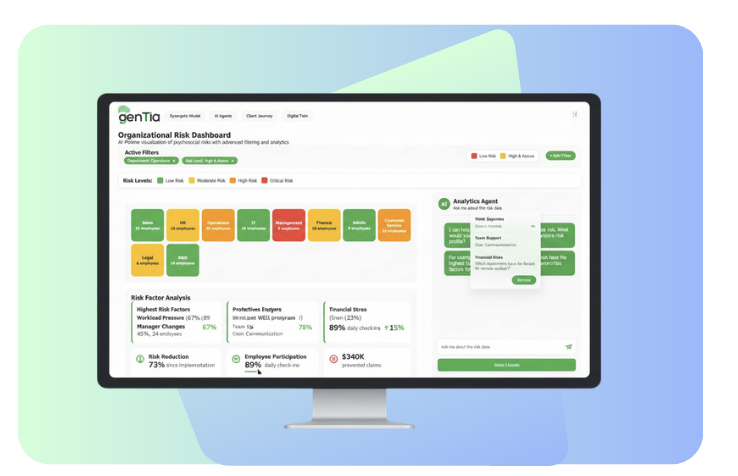
That is what a Gentia Roadmap does: it assembles what your organisation already produces into a documented picture of where psychosocial risk sits, mapped against your obligations, with a prioritised plan for what to change first.
For a single centre with a stretched director, the value wasn't a report. It was finally being able to say what the problem was, precisely enough to do something about it.
That is not a technology outcome. It is what happens when people can finally see what they are dealing with.