Turning Workplace Data into Living Risk Intelligence
Most organisations have more information about their people and workplace risks than they know what to do with.
Gentia · 2 November 2026
Employee surveys. Incident reports. Absenteeism. Turnover. Consultation records. Policies. Risk assessments.
The information exists, but it's scattered across different systems, departments and reports.
And when someone asks a simple question, such as "What's driving our biggest psychosocial risks, and are the things we're doing actually working?", finding a reliable answer can take weeks.
Even then, the answer is often a snapshot of what was happening at a particular point in time.
Six months later, another assessment begins. More information is collected, another report is written, and the process starts again.
The problem isn't a lack of data. It's a lack of connected intelligence.
Two ideas change that: Context and Loops.
1. Context: Understanding the whole picture
Information tells you what's happening. Context helps you understand why.
A survey might show employees are struggling with workload. Absence records might show an increase in sick leave. Consultation might reveal that staffing has changed, but workloads and performance expectations haven't.
Individually, these are separate pieces of information. Together, they reveal a much more useful picture of what's happening and what may be driving the risk.
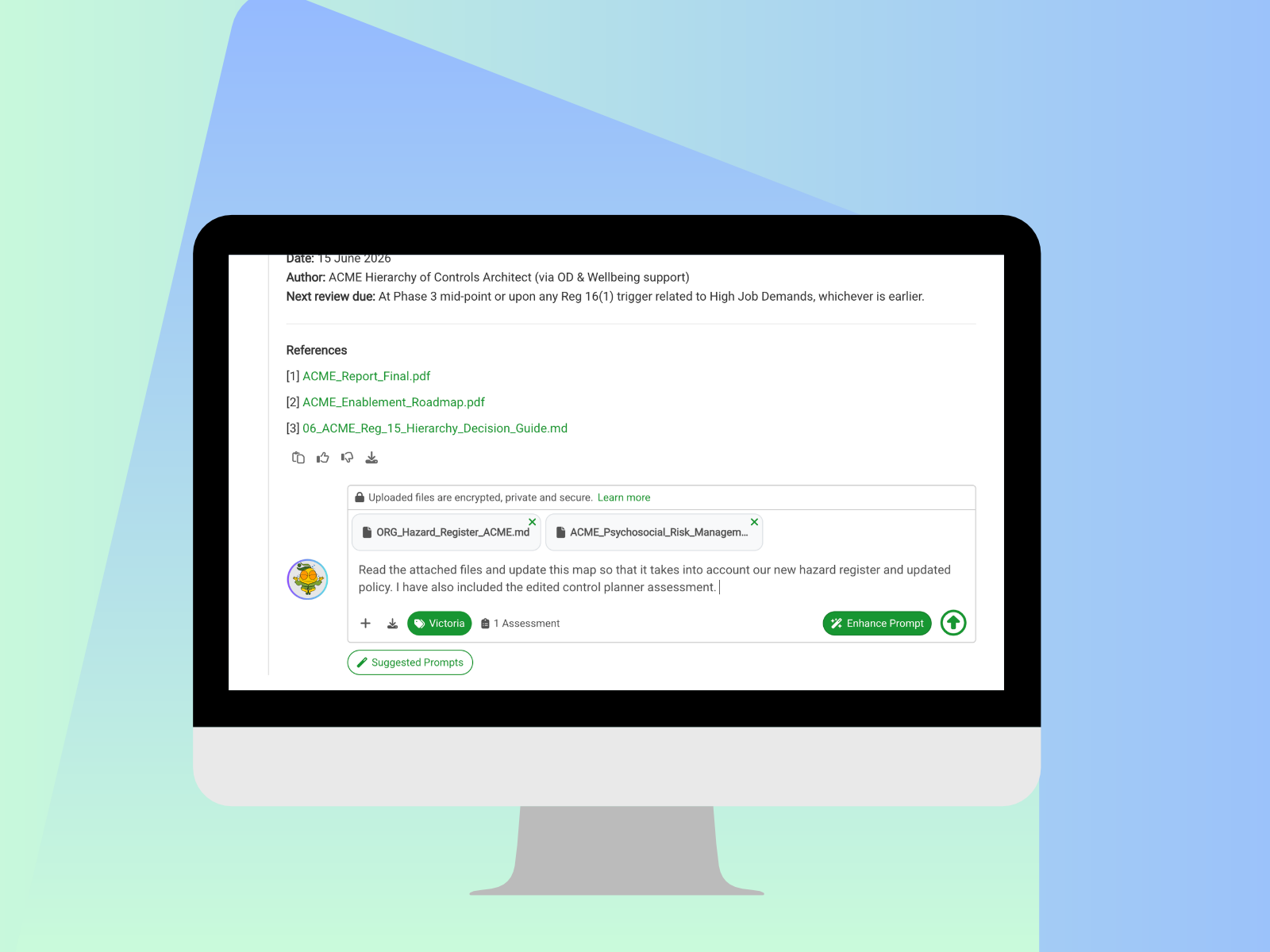
Gentia connects these signals with organisational knowledge, work practices, existing controls and relevant research and obligations.
It creates a living picture of how an organisation works, where risks exist, how they're connected and what evidence supports those conclusions.
As new information becomes available, that picture can be updated rather than rebuilt from scratch.
2. Loops: Moving from assessment to continuous improvement
Traditional psychosocial risk management often follows a familiar pattern.
Assess the risks. Produce a report. Recommend actions. Review again sometime later.
But workplaces don't stand still between assessments.
Teams change. Workloads shift. New technology arrives. Controls that looked effective on paper may not work as expected in practice.
Gentia connects these activities into a continuous cycle.
Understand the risk → Design controls → Take action → Measure what changes → Learn and adjust
Each cycle builds on what the organisation already knows.
Instead of simply recording that an action has been completed, Gentia helps organisations examine whether it has actually reduced the risk.
And when circumstances change, the organisation can reassess its risks, test its controls and adjust its approach using the evidence it has accumulated.
The difference is simple. Automation repeats a process. Intelligence learns from what happened and informs what happens next.
What this means for organisations
Gentia brings context and continuous learning together to help organisations:
- See the bigger picture: Connect workplace data, employee experiences and organisational practices to understand what's driving risk.
- Make better decisions: Identify priorities and develop practical, evidence-based controls that address the source of risk.
- Know what's working: Monitor the effectiveness of controls and understand what needs to change.
- Anticipate emerging risks: Explore how planned changes to work, technology or operations could affect people before those changes are introduced.
- Build on what they've learned: Retain the evidence, decisions and outcomes that inform future assessments and action.
Human expertise and judgement remain central. Gentia makes the evidence easier to connect, understand, question and act upon.
From periodic assessment to continuous intelligence
The real opportunity for AI in psychosocial safety isn't simply producing reports faster.
It's helping organisations make better decisions, act on them and learn whether those decisions made a difference.
Because knowing where a risk exists is useful. Understanding why it exists, what will reduce it, and whether that reduction is actually happening is what changes outcomes.
That's the thinking behind Gentia. A connected, evidence-based approach to psychosocial safety management that becomes more informed with every cycle.